|
"Finding a businessman
interested in the Arts is like finding chicken shit in your chicken
salad" I drew as I sang as I played, and so I have continued...
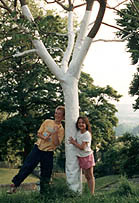
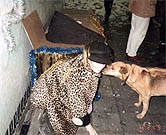
THEMES It always seems more important to me to engage with a public who will not venture into a gallery, and to work with subjects which are pressing and immediate and relevant to all of us. I try to make art vivid and memorable, and to use materials in unexpected ways. I like movement; I like colour; I like to reveal the limitations of structures and machines. Thematically the art I make is often but not exclusively about the depletion of the natural and the social environment. As this took over for ten years as my main subject matter, I became steadily conscious that I was playing a small part in a growing global movement of environmental awareness. NOTES Ah, the 80s, a decade of right-wing dominance and conspicuous consumption. Little wonder then that a lot of my work at the time was about consumerism, greed, and capitalist excess ? In the true non-conformist spirit of my ancestors, I grew closer to God the more I protested. These images are mostly taken from colour prints made from 35mm slides. Some come from my final year show at Middlesex, and these were printed up 3 months in advance of the exhibition with the kind assistance of Jon Wright. The great peace of mind I gained from having been so well prepared doubtless helped me get my First. Camouflaging Trees From Further Attack The piece was first set up in 1983 in Epping forest, then on London's South Bank in Jubilee Gardens outside County Hall, for the annual New Contemporaries exhibition where it caught the attention of BBC News. The idea is straightforward - make trees resemble
living rooms - camouflage to disguise and protect them so that they
'blend in' with the human environment which is destroying them, turning
them into (among other things) wallpaper. I first started to work with
wallpaper as a reaction to the 'blank canvas' aesthetic but became aware
of it's actual properties and true significance. Made of trees, often
depicting trees, it's dead, lifeless stuff, it stifles and contains,
and it stands for everything I hate about consumer living room culture.
I used to sell wallpaper at Texas Homecare on Saturdays. It comes in
33 ft drops; that's 3 x 11 ft pre-sized, pre-drawn and coloured canvasses. Gradually the Trees piece became more overtly
political and less simply surreal. In 1992, the Rio Earth summit was
being held, and I resurrected the piece adding posters to make the ideas
explicit. Some of the information came from a group I liked called 'Reforest
the Earth'. I wallpapered trees on Hampstead Heath, in the Bath fringe
festival, where it again hit the news, at Glastonbury, where I wore
a suit of wallpaper and was approached by teenagers who asked me to
sell drugs for them - and finally I became involved in the first nationally
recognised protest against supermarket green-belt land-grabbing, the
anti-Tesco protest at Golden Hill, Bristol. The Substrasse exhibition was curated by Heath Bunting, who tapped into the Bristol's electricity supply on order provide the power for the fairy lights on my Xmas decorated cardboard box... a mixed show held in the subway opposite the hospital - truly underground.
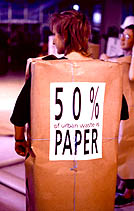
Waste High - the 'people parcels' were a group extension of the wallpapered trees - more art about deforestation, this time in my own back yard. This was quite an amazing piece to perform - a lot of bystanders knew exactly what we were doing and why, and readily expressed their approval. Physical Theatre - with a well developed sense of mischief and some
simple acrobatic techniques taught by my unicycling MY ART HISTORY - or, how I came to do this stuff...
When I was 12, Colin Short got
us all improvising drama and learning Samuel Beckett, and took us to
the Tate Gallery in London. I realised that art could be paintings as
big as walls, projected images, sounds... I loved the Pop Art colour
and understandable language of Lichtenstein and Warhol and Oldenburg,
and I was amazed at the paintings of Rothko whose work provoked a deep
emotional reaction. My father's job in printing
meant that at home despite our relatively unassuming means, I had a
supply of the best 00 fine sable brushes. I passed the 'O' level grade
easily, but the 'A' I found difficult. The good art teacher was replaced
by a bad one, my first experience of blatant corruption, an authority
figure who cheated on behalf of his prodigy, my friend Anthony Carr,
by finishing his main 'A' level submission for him after the exam was
over. Anthony got a grade A; having developed glandular fever, I got
a grade E. I left school demoralised and disgusted at the whole system.
It was the era of Punk and
New Wave and high unemployment. UB40 were in the charts and I was issuing
benefit cards, working as a civil servant, signing my friends on at
the local unemployment office. In recovery from an appendicectomy I
decided to apply to Croydon College to study Art. I turned up with my
painting and drawings in a bin liner and they let me join the course
a month late. It worked - I got into Middlesex Polytechnic (Hornsey School of Art, now Middlesex University) to study for my Fine Art degree. I made sculptures, video and audio, performance and installations, and graduated with a 1st Class B.A. Hons. It was one moment of real satisfaction after 4 years of hard work, the redemption of my earlier disappointment. It still feels good ! Fine Art was a wonderful education and it provided me with mental skills and methods which I use all the time, as well as great friends. I sometimes imagine that Art is the thing that most defines and underpins my creative self-definition. It is very difficult (some would say impossible) making career headway in the contemporary art world (some would say it's always been this way) without artistic compromise, embracing passing fashions and fads, and courting journalists. But to make Art (im)properly (in an old-fashioned Modernist way) requires absolute creative freedom. And Artists, revelling in their creative indulgence, and being inspired, vocational and often unrealistic characters, generally wish to be restrained by no considerations except their own.
Like Charles Ives, I do not believe that relying on art for income is healthy, either for the art or the artist. After working at the Tate Gallery for four years, where I saw the mid-80s Fine Art world close up, I developed a career in song writing and multi-media production, which has run parallel to my art making ever since. I enjoy the work I do, and it benefits from my Art and Music background. I produced my first CD ROM and my first multi-media website in 1994 , and I now develop interactive content with these guys. Lots of fun, and actually, lots of healthy agreement... but in Art, as yet, no sell out.
"The point is not to put poetry at the disposal of the revolution, but to put the revolution at the disposal of poetry"
|
 Alice Neel, 1900 - 1990
 trapeze-artist
girlfriend, I performed in costume(s) for four years, my favourite audience
being at the Dublin Festival of Street Performance in 1992. As a clown
you have zero status and so you can do anything. This was miles away
from the very serious art and music I was ordinarily up to, and I revelled
in the improvisatory freedom it offered, and the extraordinary power
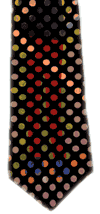
that men in make-up wield. I particularly enjoyed giving away free money.
I clowned for cash in Earls Court, advertising my good friend Hugh Fulton's
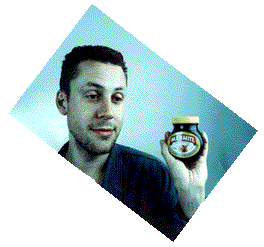
branch of Snappy Snaps. Hugh took the photo of me and my favourite product
at the top of the page. Thanks Hugh!
trapeze-artist
girlfriend, I performed in costume(s) for four years, my favourite audience
being at the Dublin Festival of Street Performance in 1992. As a clown
you have zero status and so you can do anything. This was miles away
from the very serious art and music I was ordinarily up to, and I revelled
in the improvisatory freedom it offered, and the extraordinary power
that men in make-up wield. I particularly enjoyed giving away free money.
I clowned for cash in Earls Court, advertising my good friend Hugh Fulton's
branch of Snappy Snaps. Hugh took the photo of me and my favourite product
at the top of the page. Thanks Hugh!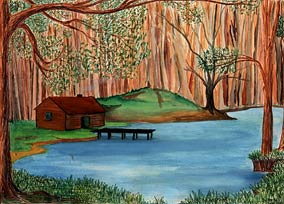 I
had a conventional British comprehensive primary school school education,
where I spent the majority of my art time constructing space vehicles
from egg boxes and cereal cartons. I could write read and spell quite
well, and so my drawing became a way to illuminate my long childish
stories which garnered adult praise and got me gold stars from the Big
Peeps.
I
had a conventional British comprehensive primary school school education,
where I spent the majority of my art time constructing space vehicles
from egg boxes and cereal cartons. I could write read and spell quite
well, and so my drawing became a way to illuminate my long childish
stories which garnered adult praise and got me gold stars from the Big
Peeps.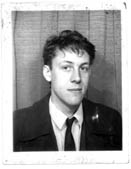
 I
often spent my Saturday job earnings on oil paint and Daler board and
constructed adolescent gothic fantasies, writing poems and songs to
match. I took my art skills pretty much for granted until I was 14,
when I was finally given the best two years of formal art education
I ever received by Stuart Revell, and was simultaneously introduced
to the music of Tom Waits by Mike Partridge. We drew from life; we were
taught colour theory, plaster, macquettes, modelling, outline, shading
technique, use of the pencil, paintbrush, paint, ink... I was shown
ways in which my brain could engage with this manual facility.
I
often spent my Saturday job earnings on oil paint and Daler board and
constructed adolescent gothic fantasies, writing poems and songs to
match. I took my art skills pretty much for granted until I was 14,
when I was finally given the best two years of formal art education
I ever received by Stuart Revell, and was simultaneously introduced
to the music of Tom Waits by Mike Partridge. We drew from life; we were
taught colour theory, plaster, macquettes, modelling, outline, shading
technique, use of the pencil, paintbrush, paint, ink... I was shown
ways in which my brain could engage with this manual facility.
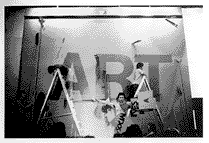 and
he instilled a life-long regard for and enjoyment of art performance,
which later flourished in my own practise. His Royal College contemporaries
Gilbert and George had, he explained, blurred the boundaries between
art and life, between life and performance, between art performance
and theatre - and so I was set fine examples, and was energised by Bruce,
well before Nike, to "Just do it !" We would do some quite
subtle things in public in Croydon's main shopping centre... twenty
or so of us drifting through the crowds, with blank white cut outs for
eyes. Just a little change and some major astonishment produced. It
made me want to work outside the gallery space.
and
he instilled a life-long regard for and enjoyment of art performance,
which later flourished in my own practise. His Royal College contemporaries
Gilbert and George had, he explained, blurred the boundaries between
art and life, between life and performance, between art performance
and theatre - and so I was set fine examples, and was energised by Bruce,
well before Nike, to "Just do it !" We would do some quite
subtle things in public in Croydon's main shopping centre... twenty
or so of us drifting through the crowds, with blank white cut outs for
eyes. Just a little change and some major astonishment produced. It
made me want to work outside the gallery space.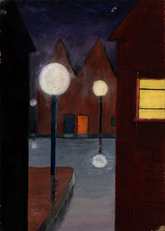 I
used to work mainly at night, to be free from the major distraction
of my family, secretly smoking Camels, and musing on the future freedom
of living away from home on an educational grant, which still existed
in those days. I went out at night, sketching under the orange streetlamps.
This gave my paintings a weird colour sense, heightened by low level
60 watt tungsten light conditions...I knew it made my work stand out
in fact, so I didn't worry about it in the slightest. I was never going
to be a conventional graphic artist. My tutor, the Royal Academician
Peter Exell, realised that I was producing my best work at home, free
from the distractions of the classroom, and generously agreed to mark
me present so long as I showed up for the art history lectures, which
I did, as they were taught by the gloriously ecccentric Peter Owen.
I also took to heart the fact that I wouldn't get into any college worth
attending unless I had a portfolio with stacks of life drawing, so two
evenings a week to the Big College up the road I put in an extra 4 hours.
I
used to work mainly at night, to be free from the major distraction
of my family, secretly smoking Camels, and musing on the future freedom
of living away from home on an educational grant, which still existed
in those days. I went out at night, sketching under the orange streetlamps.
This gave my paintings a weird colour sense, heightened by low level
60 watt tungsten light conditions...I knew it made my work stand out
in fact, so I didn't worry about it in the slightest. I was never going
to be a conventional graphic artist. My tutor, the Royal Academician
Peter Exell, realised that I was producing my best work at home, free
from the distractions of the classroom, and generously agreed to mark
me present so long as I showed up for the art history lectures, which
I did, as they were taught by the gloriously ecccentric Peter Owen.
I also took to heart the fact that I wouldn't get into any college worth
attending unless I had a portfolio with stacks of life drawing, so two
evenings a week to the Big College up the road I put in an extra 4 hours.
 So
where does that leave me ?
So
where does that leave me ?